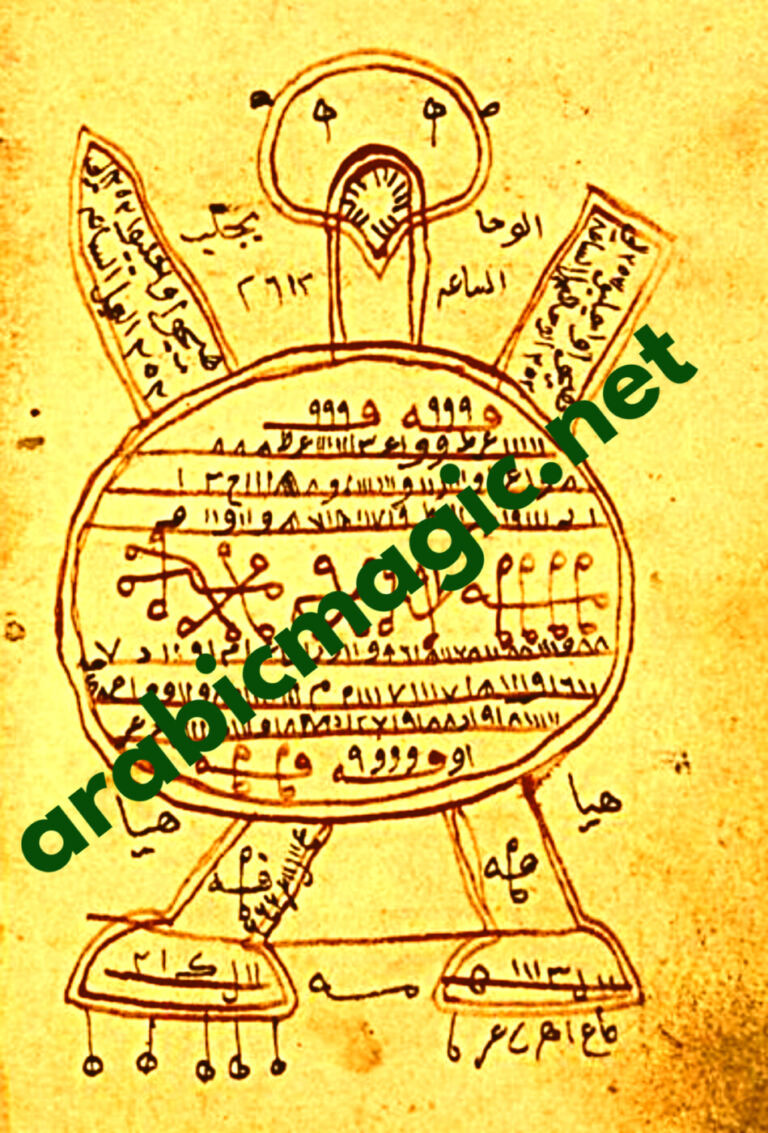
The Solomon Pact Amulet

In this article, we will introduce you to a well-known Arabic amulet distributed in a large part of the Islamic world, the legend about it, and the properties attributed to it.

The “Pact of Solomon” amulet is a scroll with an image in the form of a tower, in which are placed numerological squares, and around them the names of angels and the four Righteous Caliphs. The central part of this amulet contains the seven covenants of Solomon, from which it derives its name and about which the Arab mystic Al-Buni in his book The Sun of Great Knowledge asserts the following:

“This amulet is remarkable and of proven power, containing the seven covenants taken by Solomon. He who wears it will be protected by its baraka (life force) from all trouble by land or sea while traveling or standing still. It also contains sacred symbols of protection useful for banishing diseases and weaknesses. The seven saving signs help to ward off accidents and the evil intentions of enemies or other people, for victory over envious people, against the oppression of an unjust person and from the harm of slanderers. The blessed key symbols ease difficulties, ease birth, help trade and increase sales, attract a groom for the unattractive, help in pregnancy, victory, reconciliation, compassion, love and continuity, heal wounds, and other significant benefits through the help of God the Most High.”
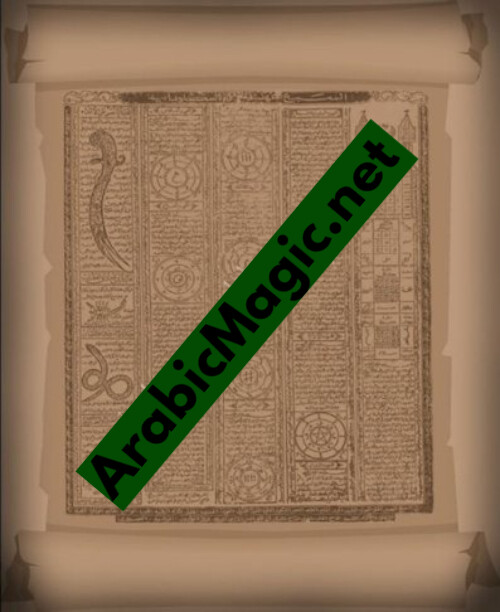
Solomon Pact - The Solomon Pact Amulet

This is the legend of how Solomon took the covenants:

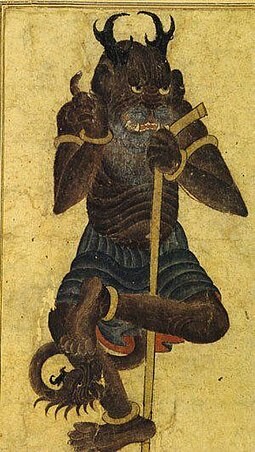
  "Once Solomon met the most terrifying and ugly looking old woman and asked her: - Are you a human or a jinn, for I have never seen anyone uglier than you? She answered him: - I am the Mother of Children who rule over sons of Adam and the daughters of Eve. I enter the houses and shout in them like a rooster, bark like a dog, bellow like a cow, bray like a camel, or like a horse and a donkey, or hiss like a snake. I take every form and bind wombs and destroy the lives of the children without being revealed. I come to the women and stop their wombs and bind them tightly so that they cannot conceive and remain barren. I come to the pregnant women and breathe on them and they are consumed, becoming unable to withhold fruit. I enter betrothed maidens or women and bring misfortune to their marriages and bridegrooms. I come to men and drink their white seed, leaving them with murky black water, no longer able to bear children. And I enter merchants and confound their business, leaving them without profit. I click the plowed ground, I breathe on it, and neither grain nor fruit can grow there. I come to the children and send them severe stabs and sharp pains so that their bones tremble and they become ugly.

The wise king, after hearing this, grabbed her tightly and said to her: – O Cursed One, you will not escape from my hands until you agree with me on terms in favor of the sons of Adam and the daughters of Eve. And she said: – O Prophet of God, I make an agreement on the condition that I will not hurt or approach any man or woman, boy or girl on whom you write these pacts and he or she carries them. The same will apply to any home or place of business or animal or possession.

Solomon asked her for these pacts, and so she was forced to give them to him, sealing each of the seven with a talisman.”

The talismans contain a name of God by which the old demon woman vows not to harm in any way the bearer of this amulet, as each vow therein states. The seven talismans concluding the oaths contain mystical symbols (known as the Seal of Solomon), and around them are placed the divine names corresponding to the covenants. The names are: Fard (The One), Jabbar (The All-Subduing), Shakur (The Appreciative), Tauwab (The Accepting of Repentance), Zaheer (The Manifest), Khabir (The All-Knowing) and Zakii (The Pure).

The amulet also contains several prayers and Quranic texts, along with three images corresponding to its benefits – for victory over enemies, for protection from scorpions, and for protection from snakes and dangers. It ends with a letter talisman and the statement:
“He who writes this talisman on paper and wears it on his head will be cured of headache. And if he lays it on any part of his body, the pain in it will disappear, by the permission of the Most High.“©

This article and all information published on this site are copyrighted. Any form of copying the texts or parts of them is prohibited. This site and all the information in it are protected by Digital Millennium Copyright Act. Any violation of this rights will be automatically detected and we will contact for assistance and legal action to your online provider and domain name registrar.

Don’t copy, be creative!
Related

  • Karabasan – The Nocturnal Jinn That Causes Paralysis

    Karabasan – The Nocturnal Jinn That Causes Paralysis

    “Suddenly I opened my eyes and felt an incredible weight press against my chest. I tried to move but to no avail. I couldn’t even draw a breath. And then I saw the creature sitting above me… I had never seen anything so ugly. I tried to scream, but no moan came out of my mouth. I began to pray in my mind to God and in a moment everything was gone.” If this experience sounds familiar to you, you are most likely one of the many who have experienced a similar phenomenon. Modern medicine defines it with the term sleep paralysis – an awake state of consciousness or sleep disturbance, which can be due to fatigue, experienced stress, irregular sleep, or the presence of psychological disorders. Undoubtedly, under the influence of such factors, one can face this phenomenon. Folk tradition and belief, however, give an entirely different explanation for its nature, associating it with an attack by demonic creatures. It is precisely this perception that I will address here, referring to the legends and numerous accounts of unexplained nocturnal visitors. In the folklore of different peoples, the spirits that attack sleeping people are called different names. In Russia – kikimora, In Croatia – moritsa, In Japan – kanashibari, and in England – The Old Witch. In Turkish and Middle Eastern folklore, they are defined as harmful jinn, mostly known as karabasan and kabus (nightmare), and in Egypt and Morocco called al-jathoom (night visitor) and boratat (the one who presses you). The most famous is the karabasan – literally black pressure, which is an evil spirit or jinn that hovers over a person while he sleeps, causing him nightmares, and feeding on his fears. It is believed that these creatures...
  • Classifications & Types of Jinn, Ways of Summoning The Jinn, Al-Mandal, Dream Divination Techniques (Istikhara)

    Classifications & Types of Jinn, Ways of Summoning The Jinn, Al-Mandal, Dream Divination Techniques (Istikhara)

    A belief in magic and the jinn plays an important part in the Arab world. The Arabs believe in the existence of beings to whom they ascribe the generic name of jinn الجن which means “to hide, to conceal”. The grammatically correct masculine singular form in Arabic is jinni and the feminine equivalent jinniya [جنية/ جني, and jinn is the plural form. Islam accepts the existence of subtle, non-human entities as part of God’s creation. According to the Qurʾān, the jinn are invisible spirits that live among us and were created before men. It is commonly believed that these spirits live in tribes and nations, and belong to different religions, whether Muslim, Christian, Jewish, or infidels (unbelievers). The Jewish and idolatrous jinn are generally held to be the worst kinds, whilst the Muslim jinn are considered good and pious. The wicked shayāṭīn شياطين or devils are the servants of Iblis who launch harmful attacks against humans. The spirits are organised in tribes under chiefs and princes. Each jinni is dangerous because, like the Arabs, the power of his tribe is behind him and will avenge him if need be. The jinn are as innumerable as the sand, being of different types, different sexes, different religions, different races, and speaking different languages. They may communicate through a human host or one may hear them as disembodied voices. Sometimes one may glimpse them, as they can assume the shape of humans or animals in order to appear to us. Yet jinn are different from humans in nature, appearance, and power. According to the Quran, they are born of smokeless fire while human beings are created out of clay (Surah al-Rahman: 14–15), which makes physical contact between them impossible. Also, jinn are invisible...
  • Arabic Magic to Detect a Thief

    Arabic Magic to Detect a Thief

    To make a thief to reveal himself, take a metal square nail and write on one side of it in Arabic: “Ya. Sin. I swear by the Quran!” On the second: “Sad. I swear by the Quran!” On the third: “Kaf. I swear by the Quran!” And on the last: “Nun. I swear by the pen and what the angels write!” Gather the people suspected of theft, drive the nail into the ground, and start reciting Surah Al-Mulk, then order the people to leave. The one of them who is the thief will not be able to move from his place and you will be able to catch him.© This article and all information published on this site are copyrighted. Any form of copying the texts or parts of them is prohibited. This site and all the information in it are protected by Digital Millennium Copyright Act. Any violation of this rights will be automatically detected and we will contact for assistance and legal action to your online provider and domain name registrar. Don’t copy, be creative! Related: Moroccan Arabic Magic Against Bad Luck Arabic Magical Potion To Drive Away Misfortunes & Attract Good Luck Magical Arabic Talisman For Prestige, Respect & Fulfillment of Desires Arabic Tweez for Child Protection Ancient Arabic Magic & Oriental Occultism

  • Ancient Arabic Magic & Oriental Occultism

    Ancient Arabic Magic & Oriental Occultism

    The Arabic magic is a mysterious occult science with a complex history. Coming from the exotic lands of the Orient and described in the tales of 1001 Nights, it remains shrouded in secrecy to present days. Although it is closely related to Islam and its mystical branches, its roots can be traced to the pagan beliefs of the ancient Mesopotamian civilizations. Subsequently developed and practiced by the Chaldeans, Sabean, and Nabataeans, who were called “stars worshipers” and were considered the wisest of their time. Pre-Islamic beliefs paid homage to many deities who were closely related to the seven celestial bodies. With the advent of Islam, some of these beliefs were lost or destroyed, and others were incorporated and absorbed by various early Islamic religious and spiritual cults. The great development of these occult teachings took place in the Middle Ages with the flourishing of Islamic culture, when remarkable and famous philosophers, scholars, and sages, including Al-Buni, Ibn Arabi, Al-Biruni, and Al-Ghazali, wrote and transcribed in Arabic numerous magical treatises and works with esoteric knowledge, astronomy, astrology, philosophy, and a number of other sciences for their students and the future generations. Some of them were translated into Latin, and a small part of these teachings passed into the Western occultism. From the whole blend of magical beliefs, spiritual and religious-philosophical teaching later is formed a complex system of rites and magical practices which in the Middle Eastern world is called with the generic term Rouhaniya that means Spirituality, and this term is used to denominate the Arabic magic. Among the initiates, it is also called Simiya or Ilm al-Hikma “Knowledge of Wisdom”. Those who practice these teachings are called mukarribun or “seekers of Divine closeness.” In the occult Western traditions, this...
  • Moroccan Arabic Magic Against Bad Luck

    Moroccan Arabic Magic Against Bad Luck

    This ritual performed by the Moroccan wizards aims to remove bad luck from the victim by transferring it to another person or animal, and this way to attract good luck towards you. This article and all information published on this site are copyrighted. Any form of copying the texts or parts of them is prohibited. This site and all the information in it are protected by Digital Millennium Copyright Act. Any violation of this rights will be automatically detected and we will contact for assistance and legal action to your online provider and domain name registrar. Don’t copy, be creative! Related: Arabic Magical Potion To Drive Away Misfortunes & Attract Good Luck Rue – An Herb For Attracting Good Luck & Prosperity Arabic Magic to Detect a Thief Ancient Arabic Magic & Oriental Occultism The Jinn’s Meal – Ritual for Healing
  • Qareen- The Jinn Companion

    Qareen- The Jinn Companion

    Qareen is the name of a particular class of Jinns, which literally translates to “permanent companion”. It is believed that with the birth of each person, a lifelong companion or personal jinni (genie) is appointed to him, who accompanies him until his death. In the different cultures and traditions, this companion is called by different names, in Persian and Urdu it is called Hamzat, by Sanskrit Saia, and in ancient Roman mythology it is described as a personal genius capable of influencing and inspiring people. The concept of a doplleganger spirit is very old and most likely comes from the “Ka” (spiritual essence) from the ancient Egyptian religion, as well as from some animistic beliefs found in Egypt and Arabia from the time of the coming of Islam. According to orthodox Islamic beliefs, it is assumed that all the Qareen are negative or demonic (sheitans), whose sole purpose is to lead a person in a bad way. On the other hand, if our jinn escort is spiritual and positive, it can affect us for good by directing us in the right direction. Qareen can be affected by our actions or lifestyle, which if they are harmful to him, he would respond by whispering depressive and depleted thoughts, or would mislead us in situations that harm us. That is why many Arab sorcerers and healers have sought ways to protect against these beings and their impact. The hadith mention that the Prophet Mohammad managed to make his Qareen accept his faith, and so the latter continued to advise him and direct him until the end of his pious life. In many cases of an established connection with a spiritual teacher or leader, it is a matter of communicating with a personal...