

Iṣyān al-Dahr, The Unseen Amulet of Long Life, Anti Aging & Good Health
€700.00
Only 1 left in stock
Description
He is known as Iṣyān al-Dahr (عِصْيَان الدَّهْر), the Defiance of Time, a name spoken only in fragments and rarely written whole. Among those who know of him, it is understood that names carry weight, and this one carries opposition itself. Iṣyān al-Dahr is a jinn whose existence is an argument against inevitability. From the dawn of humanity, when the first human understood that breath could end and flesh could fail, Iṣyān al-Dahr took form as resistance made conscious. He did not emerge to comfort mortals, nor to rule them. He arose to contest the forces that sought to shorten their span: death, old age, and disease. Where others accepted decay as law, he declared it an enemy.
In the earliest ages, when humans lived brief and uncertain lives, Iṣyān al-Dahr observed quietly. He watched sickness move through camps like fire through dry grass. He saw strength fade into frailty and memory dissolve before its time. Death was not distant then; it was constant, casual, unquestioned. Iṣyān al-Dahr learned its habits. He learned how illness weakened the body, how time eroded the mind, how accidents exploited moments of distraction. His war did not begin with violence. It began with study. He memorized the rhythm of endings so he could interrupt them. Every life that endured longer than expected fed his purpose, strengthening his presence in the unseen layers of the world.
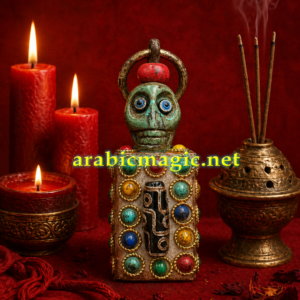
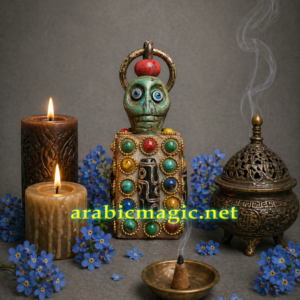
Long before recorded history, Iṣyān al-Dahr shaped the first of his amulets. These were not ornaments or symbols of allegiance. They were bindings, forged through immense sacrifice. Each amulet required him to anchor a fragment of his will into the material world, permanently limiting himself in exchange for creating a conduit of resistance. Only a few were ever made, because each one weakened him even as it empowered its bearer. The amulets were never meant for crowds or armies. They were meant for individuals capable of carrying extended existence without squandering it. To possess one was to step into an ancient conflict already in progress.
Those who bore the amulet of Iṣyān al-Dahr and worshiped him entered into a demanding pact. Worship, to him, was not blind praise or ritual excess. It was recognition. It was daily acknowledgment that survival was not accidental. His chosen were required to honor life through discipline, restraint, and awareness. In return, Iṣyān al-Dahr bent probability itself around them. Bullets veered by margins too small to measure. Blades glanced where they should have pierced. Accidents unraveled seconds before becoming fatal. Vehicles stalled, structures collapsed elsewhere, and disasters arrived just late enough. Death reached, and found its grip slipping.
Old age, the slowest and most insidious of enemies, was restrained but never erased. Those protected by Iṣyān al-Dahr aged at a different tempo. Their bodies weakened slowly, unevenly, as if time itself hesitated in their presence. Strength lingered. Vision stayed sharp. The mind retained clarity long after others declined. Wrinkles and frailty arrived late, and sometimes not at all until very advanced years. Iṣyān al-Dahr did not preserve youth for vanity’s sake. He preserved capability. His followers remained functional, dangerous to decay, and frustratingly unpredictable to the forces that depended on decline.
Disease fared no better against him. Illness still approached, but its certainty dissolved. Infections softened. Chronic conditions stalled. Plagues lost their teeth near those bound to him. Recovery occurred without explanation, leaving healers confused and records quietly corrected. Iṣyān al-Dahr did not heal through mercy. He denied disease authority. To him, sickness was another form of invasion, and invasions could be resisted. Over centuries, clusters of improbable survivals formed patterns, and those patterns drew attention from scholars who learned not to ask too many questions.
Yet Iṣyān al-Dahr was never gentle, nor endlessly forgiving. His protection was not a license for excess or arrogance. Bearers who treated the amulet as a shield for recklessness found its influence thinning. He despised wasted survival. To live long without purpose was an offense greater than death itself. Some who grew arrogant under his protection died suddenly when it withdrew, often at moments when they believed themselves untouchable. These were not punishments delivered in anger. They were absences. Iṣyān al-Dahr simply stopped intervening, and death reclaimed what it had been denied.
Across history, the amulets surfaced and vanished like deep currents. A general rumored to survive every battlefield. A physician who lived long enough to see entire medical paradigms rise and fall. A woman recorded as dying in one century and appearing under another name generations later, unchanged in spirit. None ever confessed the truth. Iṣyān al-Dahr discouraged exposure. His war required subtlety. Too much attention strengthened death’s resolve. Too much worship diluted meaning. The amulets were meant to move quietly through history, altering it by persistence rather than spectacle.
While his bearers enjoyed extended lives, Iṣyān al-Dahr himself never rested. Beyond human perception, he remained locked in constant struggle. Every new weapon refined death’s efficiency. Every unchecked disease gave it new confidence. Even advancements meant to prolong life threatened stagnation, and stagnation invited decay. Iṣyān al-Dahr adapted endlessly, adjusting his protections, rewriting chance around those bound to him. He did not oppose progress. He opposed surrender. To him, death was not a sacred law, but a habit reinforced by acceptance.
Today, only a few amulets are believed to remain, and the name Iṣyān al-Dahr is nearly erased from common knowledge. Yet his defiance continues. Somewhere, someone survives what should have ended them. Somewhere, age hesitates and illness falters. Iṣyān al-Dahr does not promise immortality. He promises resistance. As long as humanity refuses to accept decay as destiny and death as unquestionable truth, he endures, watching carefully, choosing rarely, and continuing his ancient war against time itself.
The magical talismans and amulets that we offer are not commercial products but are entirely handmade charged with the correct Arabic rituals under strict control for performing all necessary requirements and favorable time for their creation. To order, please use the email below: [email protected]